

The EB-5 Visa, also known as the Immigrant Investor Program, is a United States visa program created by the Immigration Act of 1990. It provides a method for eligible immigrant investors to become lawful permanent residents, informally known as GreenCard holders, by investing in a commercial enterprise in the U.S. that creates or preserves ten permanent full-time jobs for qualified U.S. workers. The primary goal of the EB-5 program is to stimulate the U.S. economy through job creation and capital investment by foreign investors. Over the years, the program has undergone several changes and has become an attractive option for high-net-worth individuals seeking a path to U.S. citizenship.
EB-5 Visa
A Reliable Path to Permanent Residency in the United States

BENEFITS FOR EB5 INVESTORS
The EB-5 Visa program offers numerous benefits to foreign investors and their families. One of the most significant advantages is the ability to obtain U.S. permanent residency, which provides the right to live, work, and study anywhere in the United States. This opportunity is particularly appealing to those seeking to access the high-quality education system in the U.S., as children of EB-5 investors can attend public schools and universities at the same tuition rates as U.S. residents.
Green Card for Main Applicant, Spouse, and Children Under 21
The EB-5 program grants Green Cards to the main applicant, their spouse, and any unmarried children under the age of 21 at the time of application, allowing the entire family to enjoy permanent residency in the United States. Path to US Citizenship
Investors and their families can eventually apply for U.S. citizenship, providing a secure and long-term solution for those seeking to establish a new life in America. Freedom to Work, Travel, and Live Anywhere in the US
EB-5 visa holders can live, work, and travel freely across the United States without any restrictions, offering unparalleled flexibility and opportunities. Permanent Resident Status
As permanent residents, EB-5 investors and their families can enter and exit the United States with ease, enjoying all the benefits that come with this status. Business Opportunities
The EB-5 visa allows investors to start and operate a business in the United States without facing immigration restrictions on the enterprise, fostering entrepreneurial growth and innovation. Education for Children
Children of EB-5 investors can access the U.S. public school system, receiving a high-quality education and a wide range of opportunities. No Language or Professional Experience Requirements
The EB-5 program does not require applicants to have specific language skills or professional experience, making it accessible to a broad range of investors. Fastest Route to a Green Card
Depending on the immigrant’s country of birth, the EB-5 program may offer the quickest path to obtaining a Green Card compared to other visa categories like EB-2 or EB-3, making it an attractive option for many international investors.
The EB-5 program grants Green Cards to the main applicant, their spouse, and any unmarried children under the age of 21 at the time of application, allowing the entire family to enjoy permanent residency in the United States. Path to US Citizenship
Investors and their families can eventually apply for U.S. citizenship, providing a secure and long-term solution for those seeking to establish a new life in America. Freedom to Work, Travel, and Live Anywhere in the US
EB-5 visa holders can live, work, and travel freely across the United States without any restrictions, offering unparalleled flexibility and opportunities. Permanent Resident Status
As permanent residents, EB-5 investors and their families can enter and exit the United States with ease, enjoying all the benefits that come with this status. Business Opportunities
The EB-5 visa allows investors to start and operate a business in the United States without facing immigration restrictions on the enterprise, fostering entrepreneurial growth and innovation. Education for Children
Children of EB-5 investors can access the U.S. public school system, receiving a high-quality education and a wide range of opportunities. No Language or Professional Experience Requirements
The EB-5 program does not require applicants to have specific language skills or professional experience, making it accessible to a broad range of investors. Fastest Route to a Green Card
Depending on the immigrant’s country of birth, the EB-5 program may offer the quickest path to obtaining a Green Card compared to other visa categories like EB-2 or EB-3, making it an attractive option for many international investors.
EB-5 VISA PROGRAM COST & REQUIREMENTS
To qualify for an EB-5 Visa, investors must meet specific criteria. The most significant requirement is making an at-risk investment of at least $1.8 million in a new commercial enterprise. These investment thresholds were established to ensure that the capital contributes significantly to economic development and job creation. The investment must be in a new commercial enterprise, which can include any for-profit activity formed for the ongoing conduct of lawful business.
The new commercial enterprise must create or preserve at least ten full-time jobs for qualifying U.S. workers within two years of the investor’s admission to the United States as a Conditional Permanent Resident. These jobs must be direct jobs if the investment is made directly into the commercial enterprise, or indirect jobs if the investment is made through a Regional Center. Regional Centers are USCIS-approved economic units, public or private, that promote economic growth, improve regional productivity, create jobs, and increase domestic capital investment.
OR
AND
| EB-5 Visa Investment Amount | Invested into | Amount* |
|---|---|---|
| Project located in Targeted Employment Area (TEA) EB-5 Investment Amount | US Commercial Enterprise | $800,000 |
| EB-5 Visa Investment Amount | Invested into | Amount* |
|---|---|---|
| Project located in Non-Targeted Employment Area (Non-TEA) EB-5 Investment Amount | US Commercial Enterprise | $1,050,000 |
| EB-5 Visa Typical Costs | Paid to | Amount* |
|---|---|---|
| Admin Fees | Investment Issuer (Regional Center) | Project Variable |
| Legal Fees | Immigration attorney | $25,000 – $35,000** |
| Processing Fees | USCIS | To be determined by USCIS |
The EB-5 program mandates that the investment be an “at-risk” investment in a U.S. commercial enterprise. This means there can be no guarantee of the return on investment, as such guarantees would disqualify the investor from obtaining a permanent Green Card. However, this requirement does not imply that the EB-5 investment must be excessively risky. Risk can be mitigated through careful deal structuring of the EB-5 Investment Offering.
One EB-5 investment allows the main applicant, their spouse, and any unmarried children under 21 to obtain permanent Green Cards. However, the investor does not receive immediate immigration benefits upon applying. They may need to wait more than a year for the approval of their I-526E application. Only after this approval will they be allowed to immigrate to the United States. Applying for an EB-5 visa does not affect other ongoing forms of U.S. legal status, such as H1-B, F-1, or B-1 visas.:
1.A Conditional Green Card: Typically received approximately one to three years from the moment of application, which involves filing an I-526E petition.
2.Employment Authorization Document (EAD) and Advanced Parole Travel Permit: These can be obtained within months of application if the investor has a current U.S. student or work visa and concurrently files an I-485 change of status along with their I-526E petition.
The timeline for these processes can vary, being shorter or longer depending on factors such as the investor’s country of birth and current visa status in the United States. Some investors may benefit from faster processing times depending on the specific YDY CAPITAL project they invest in.
Recent EB-5 legislation mandates that USCIS process petitions within 60 to 240 days. If this timeframe is met, the time to obtain a Green Card should be closer to one year.
In summary, while the EB-5 investment must be at risk, various measures can mitigate this risk. The program offers a reliable pathway to permanent residency for the investor and their immediate family, with flexible timelines and additional benefits depending on individual circumstances and specific investments.
US EB-5 GREEN CARD PROCESS & TIMELINE
Stage 1: Do your Research
Step 1: Understand What EB-5 Is and Its Timeline
Start by researching the EB-5 program. This immigration-by-investment initiative differs from other 'golden visa' programs offered by other countries, as it involves a stringent initial review of the source of funds and eventually requires proof of job creation. The investment process typically takes between 3 to 7 years, with each EB-5 project having a distinct loan term and payback structure.
Step 2: Determine If EB-5 Works for You
The EB-5 program requires a minimum investment of $800,000. If you currently hold a non-immigrant visa in the U.S., you need to evaluate whether the benefits of obtaining a Green Card outweigh the need to renew your non-immigrant visa every three years. An additional benefit exists for foreign nationals already in the U.S. on visas like F-1, H-1B, or L1A, as they can concurrently file for adjustment of status and receive EAD Work Authorization more quickly, typically within 3-4 months.
Step 3: Verify Your Source of Funds
A critical component of the EB-5 program is demonstrating the origin of your investment funds. Whether the funds come from your earnings, assets, or gifts/loans from friends and family, you must provide documentation for all sources of money involved in the investment and associated fees. The entire investment amount and all related fees must be accounted for and wired into the project before filing your immigration petition. Even if you don't currently have all the necessary funds, we encourage you to conduct your research and arrange a consultation with YDY CAPITAL We understand that the EB-5 investment is a significant, long-term decision, and we are available to answer any questions as you plan for your and your family's future.
Step 4: Make Your Decision
After thoroughly considering all the information, decide whether the EB-5 program is the right choice for you. YDY CAPITAL is happy to refer you to an experienced immigration attorney who can best handle your petition, ensuring you receive the expert guidance needed throughout the process.
By following these steps, you can make an informed decision about participating in the EB-5 program and take the necessary steps to secure a prosperous future for you and your family.
Stage 2: Begin your EB-5 Process (First 1 to 3 months)
Step 5: Engage an Immigration Attorney and Start Your Source of Funds Process
The first step in your EB-5 process is to engage an immigration attorney who will assess your source of funds. Once you have retained their services, your attorney will begin by gathering your basic information, travel history, and the required documentation for your source of funds. If your funds are not fully liquid, the attorney will guide you in mobilizing them. They will outline the necessary documentation for each source, which could include gifts, loans against property, sale of assets, income, and more. This stage involves providing multiple documents, and the process can take anywhere from a few weeks to a few months, depending on how quickly you can supply the required documentation.
Step 6: Identify a Project That Meets Your Objectives
Conduct thorough due diligence on the project that aligns best with your immigration and investment goals. We recommend setting up a Zoom call with one of our professionals at YDY CAPITAL to review the available project options. While your immigration attorney cannot recommend specific projects, they can assist in performing due diligence on the immigration aspects of your chosen project.
Step 7: Sign Documents and Send Funds to Escrow
After your immigration attorney has gathered all the required documentation and completed the source of funds process, they will instruct you to send your investment capital to the project’s escrow account. Once you sign the signature packet and wire the funds, we will countersign the documents and issue a wire transfer receipt, reflecting the full amount and administrative fees wired to us. This final documentation is what your attorney needs to file your I-526E Petition.
Step 8: Submit Your I-526E Petition
With all required documentation for your source of funds, wire transfer receipts, and countersigned documents from YDY CAPITAL, your attorney can submit your I-526E petition to the USCIS. The I-526E Immigrant Petition by Alien Entrepreneur includes: 1) Proof of how the investor earned all funds used in the EB-5 investment, and 2) Details on how the funds will be used to create the 10 jobs required to provide the investor and their family members with immigration benefits. Approximately 10 days after submission, you will receive an I-797C receipt notice from USCIS, indicating they have received your petition (this timeline may vary). The receipt notice will include the date they received your petition, marking your official "Priority Date." At this point, if you are in the United States on a non-immigrant visa, your attorney may advise you to file for Adjustment of Status, allowing you to receive an EAD Work Authorization and Advanced Parole Travel Permit before your petition is approved.
Rural Priority I-526E Processing: Projects with Rural Targeted Employment Area (TEA) designation receive priority I-526E processing. Currently, investors are experiencing an average 6-month processing time for Rural Projects.
Non-Rural I-526E Processing: Post-RIA, we have not seen I-526E approvals for Non-Rural Projects, and processing times remain unknown. By following these steps, you can navigate the EB-5 process efficiently and move closer to securing your familys future in the United States.
Stage 3: Wait for I-526E Approval and Employment Authorization Document (EAD) / Advanced Parole (AP) Travel Permit
Step 9: Wait for USCIS to Approve Your I-526E Petition
Once you have submitted your I-526E petition, the approval process begins. This timeline can vary widely and is influenced by the specific project you invest in. For rural projects, approvals are currently being received within 1-12 months, averaging around 6 months. However, the approval timeline for urban projects is still uncertain. It's important to note that the order of approvals is not always sequential based on the submission date of each I-526E petition.
During this waiting period, if you are outside the U.S., you will not have any legal immigration status. To keep you informed and engaged, YDY CAPITAL will provide you access to your respective project portal. Through this portal, you can monitor the progress of your investment, receive important tax documents, and enter your bank information for receiving interest payments.
Step 10: Wait for Employment Authorization Document (EAD) and Advanced Parole (AP) Travel Permit
This step is relevant only to EB-5 petitioners who are currently in the United States on a nonimmigrant visa, such as an F-1 student visa or an H-1B work visa. While your I-526E petition is pending, you may apply for Adjustment of Status (subject to visa availability for your country) and subsequently wait for your EAD and AP cards. The average waiting time is 3-4 months for an EAD and 7-8 months for an AP travel permit.
During this period, it's crucial to consult with your immigration attorney to fully understand the benefits of these documents and to receive guidance on any actions you should take while your I-526E petition remains pending.
By following these steps, you can efficiently navigate the EB-5 process and take important strides towards securing permanent residency and eventually citizenship in the United States.
Stage 4: I-526E Approved, Priority Date Current, Apply for Conditional Green Card (6 to 12 Months)
Step 11: Consular Processing / Change of StatusOnce your I-526E petition is approved and your priority date is current, you can proceed to apply for a conditional Green Card. This process varies depending on whether you are inside or outside the United States. For Applicants Outside the US: Consular Processing: You will undergo a visa interview process at a U.S. consulate in your home country. This process includes a thorough document review, a medical examination, and a personal interview. Timeline: Setting up the interview can take approximately 6 months, depending on your local consulate's schedule. Immigrant Visa: After successfully completing the interview, you will receive an immigrant visa stamped into your passport. Relocation: With the immigrant visa, you can then move to the United States. Green Card Issuance: Upon your arrival in the U.S., your conditional Green Card will be issued and sent to you.
Stage 5: Start Conditional Residency (1 Year 9 Months)
Step 12: Begin 2-Year Conditional ResidencyUpon receiving your conditional Green Card in the mail, you will begin your 2-year conditional residency period. This Green Card is similar to a regular permanent resident card, but with certain conditions that must be met to transition to permanent residency. Your investment must result in the creation of at least 10 full-time jobs. Your investment must remain 'at-risk' for the full 2-year period. As of October 11th, 2023, USCIS has redefined the 2-year at-risk condition to start from the date when an investor has fully funded the New Commercial Enterprise (NCE) and filed their petition. At YDY CAPITAL, we structure our projects with a significant job creation buffer, ensuring that more than enough jobs are created to meet the EB-5 requirements. The return of your investment will depend on the specific project you have selected and its repayment terms. During your conditional residency period, it is crucial to monitor the progress of your investment and ensure that all conditions are being met. This proactive approach will help facilitate a smooth transition to permanent residency at the end of the 2-year period.
Stage 6: Apply for Permanent Residency (3 Months Before Expiration of Conditional Green Card)
Step 13: File I-829 for Removal of Your Conditions
In the final 90 days of your 2-year conditional residency, your attorney will file the I-829 petition to remove the conditions on your Green Card. This petition demonstrates that you have met all the requirements of the EB-5 program, including job creation and maintaining the investment at-risk. During this period, you will continue to reside in the United States as a Green Card holder while your I-829 petition is being processed.
Step 14: Receive Unconditional Green Card once the I-829 is Approved.
Once your I-829 petition is approved, you will receive your unconditional Green Card, marking the completion of your EB-5 journey. With this permanent resident status, you are free from the initial conditions of your Green Card.
Path to U.S. Citizenship
After holding permanent residency for 4 years and 9 months (starting from the date you obtained your conditional residency), you are eligible to apply for U.S. citizenship. Consult with your immigration counsel to understand the next steps if you wish to pursue naturalization and become a U.S. citizen.
By following these steps, you can successfully navigate the EB-5 process from initial investment to achieving permanent residency and potentially U.S. citizenship.
WHAT IS PRIORITY PROCESSING?
Priority Processing is a feature of the EB-5 program that offers expedited processing times for I-526E petitions, particularly for Rural TEA Designated Projects. EB-5 investors participating in these rural projects are now experiencing approval times ranging from 1 to 12 months, with an average processing time of approximately 6 months.
Rural TEA Designated Projects: These projects are located in rural areas, defined as towns with fewer than 20,000 people within a county that lacks a metropolitan statistical area. EB-5 Reform & Integrity Act (RIA) of 2022: Passed on March 15, 2022, this act mandated the USCIS to reduce processing times for I-526E petitions in rural TEA designated projects under Priority Processing. Current Processing Times: Approved rural investors have realized an average 6-month processing time for their I-526E petitions. Non-Rural Projects: EB-5 investments in non-rural areas continue to be processed under standard processing times. As of now, there have been no I-526E approvals post-RIA for non-rural projects, so the exact processing times for these petitions remain uncertain.
WHAT ARE EB-5 REGIONAL CENTERS?
The EB-5 Regional Center Program stands as a beacon of opportunity for foreign investors seeking to obtain permanent residency in the United States while simultaneously stimulating the American economy. This program, established by the U.S. Congress in 1990, offers a unique pathway for eligible individuals to secure a green card by making a qualifying investment in a commercial enterprise within a designated Regional Center. At its core, the EB-5 visa program was designed to attract foreign investment to the United States and create employment opportunities for American workers. However, the Regional Center Program introduced an innovative approach by allowing investors to pool their resources into larger-scale projects managed by federally approved Regional Centers. A Regional Center is an entity designated by the United States Citizenship and Immigration Services (USCIS) that focuses on promoting economic growth within a specific geographic area. These centers facilitate job creation through the investment of EB-5 capital into various projects, such as real estate developments, infrastructure initiatives, and business ventures. The inception of the EB-5 Regional Center Program marked a significant milestone in the evolution of the EB-5 visa category. Initially, the program faced skepticism and uncertainty, but over time, it gained traction as an effective tool for stimulating economic development and revitalizing communities across the nation.
EB-5 PROGRAM FAQS
What is an EB-5 visa?
An EB-5 visa is a U.S. immigrant visa, also known as a permanent residency visa or Green Card. Green Cards are typically issued through a lottery, family-based relationships, or employment-based sponsorship. The EB-5 visa, standing for Employment-Based 5th Category Visa, is an immigration-by-investment program designed to stimulate U.S. job creation. By investing in a U.S. commercial enterprise and meeting specific job creation requirements, foreign nationals can obtain permanent residency in the United States through the EB-5 program.
Who applies for an EB-5 visa, or who is the primary EB-5 visa applicant?
An EB-5 petitioner is an individual investor seeking U.S. permanent residency through the EB-5 Immigrant Investor Program. In addition to the primary investor, the investor's spouse and unmarried children under the age of 21 can also obtain Green Cards through the same investment. Notably, minors are eligible to apply as primary EB-5 petitioners, provided they meet all program requirements.
Why do EB-5?
Immigrant investor programs are designed to attract foreign capital and businesspeople by providing the right to residence and citizenship in return. The United States, renowned for its economic opportunities and quality of life, remains one of the most attractive destinations for immigration. The EB-5 Regional Center program is highly favored among foreign nationals looking to move to the United States. If you are currently on a non-immigrant visa such as H-1B, F-1, or L-1A, obtaining a Green Card through the EB-5 program is a strategic way to secure your and your family’s future in the United States. Although you might have an EB-2 or EB-3 petition pending, the wait times for these categories are often long and uncertain, which can delay your ability to obtain a Green Card. Obtaining a Green Card via the EB-5 program offers several advantages: Permanent Residency: It eliminates the need for constant renewals of non-immigrant visas every few years. Stability: It reduces the risk of having to leave the country due to changes in your visa status, employment, or personal circumstances. Career Flexibility: For individuals on H-1B status, the EB-5 program provides greater career flexibility without the constraints of continuous status extensions. By expediting the Green Card process, the EB-5 program offers a reliable path to permanent residency, ensuring a more secure and stable future for you and your family in the United States.
What are the Basic Requirements for an EB-5 visa?
The EB-5 visa program stipulates that each investor must make a substantial financial commitment to qualify for a Green Card. Specifically, an investor is required to invest $800,000 if the project is located in a Targeted Employment Area (TEA), which includes rural areas or areas with high unemployment. For projects outside of a TEA, the required investment amount is $1.05 million. In addition to the financial investment, the program mandates that the investment must result in the creation of at least 10 full-time jobs for U.S. workers. These jobs must be maintained throughout the investor's conditional residency period. Initially, successful applicants receive a conditional Green Card, valid for two years. At the end of this 2-year conditional residency period, the investor must demonstrate that the investment has been maintained and that the required 10 jobs have been created. This proof is necessary for the Green Card to transition from conditional to permanent status. By meeting these requirements, investors and their immediate families can secure and maintain permanent residency in the United States through the EB-5 program.
What are the Capital Requirements for an EB-5 Investment?
Proper documentation of the source of funds is a critical aspect of the EB-5 investment process. The funds required for the investment may come from various sources, including, but not limited to, the accumulation of salary, earnings from business ownership, proceeds from the sale or mortgage of real estate property, gifts, and inheritance. Investors can also utilize loans for their EB-5 investment, with the best practice being that these loans are secured by an asset. It is essential that the funds used for the investment legally belong to the investor and can be sourced from anywhere in the world, provided they meet legal requirements. Ensuring that the source of funds is well-documented and legitimate is crucial for the approval of the EB-5 petition.
What is the EB-5 Regional Center Program?
TThe EB-5 Regional Center Program was established in 1993 to enable multiple investors to pool their capital, thereby amplifying economic impact within a defined geographic area. This program allows EB-5 investors to make passive investments in projects managed by Regional Centers and issuers who possess specialized knowledge and expertise in the EB-5 process. By pooling resources, the program facilitates larger-scale projects and broader economic growth while offering investors a streamlined path to meet the job creation and investment requirements of the EB-5 visa program.
Can EB-5 investors receive their capital back?
The primary objective of a typical EB-5 investor is to obtain a Green Card and eventually receive their investment principal back. Well-structured EB-5 offerings include a detailed exit strategy, ensuring that investors are repaid in full, often with interest. The capital must remain invested, or at-risk, until the investor completes their conditional residency period. If the investment is withdrawn prematurely, the investor’s Green Card will not transition to permanent status. While EB-5 investments are required to be at-risk, this does not imply that the investment needs to be inherently 'risky.' Proper structuring and management can mitigate potential risks, providing a more secure investment environment while still complying with the program's requirements.
What are the types of EB-5 Projects?
EB-5 projects can be found in a wide variety of industries and can involve many different business models. Here are some of the most common types of EB-5 projects:
- Mixed-use retail
- Hotels
- Sports stadiums
- Restaurants
- Agricultural developments, including wineries and farms
- Electric vehicle manufacturing
- Manufacturing
- Biotech and medical technologies
- Casinos
- Entertainment venues
- Convention centers
- Office buildings
It is important to remember that not all businesses are eligible for EB-5 investment. To be eligible, a business must create a certain number of jobs and be located in a targeted employment area (TEA). A TEA is a rural area or an area with high unemployment.
What does a typical EB-5 Project Model look like?
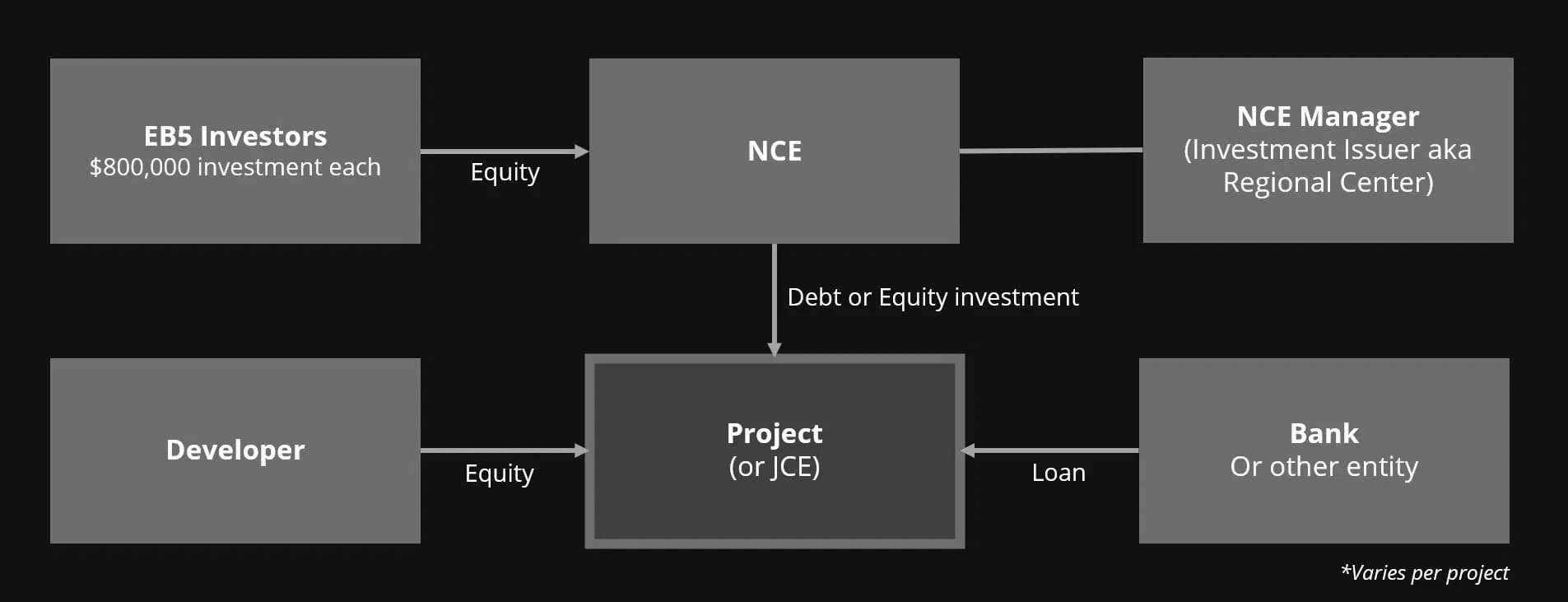
Most EB-5 investments focus on real estate development due to the relative ease of job creation through construction activities.
New Commercial Enterprise (NCE): The NCE is the entity into which EB-5 investors place their funds. The NCE Manager, who issues the security, oversees the management of this enterprise. The invested capital from the NCE is then deployed as either a loan or equity to the Job Creating Entity (JCE).
Job Creating Entity (JCE): The JCE is the project entity where job creation occurs. In a standard EB-5 project, each investor buys a share of the NCE. The pooled funds from the investors are then either loaned to the EB-5 project or invested as equity. The additional capital required to complete the project may come from various sources, such as developers, bank loans, grants, investment funds, or other financial sources.
Loan Model Projects: In this model, the NCE makes a loan to the project. Each project has a coupon rate and a loan term or maturity date. The coupon rate is paid throughout the loan term, starting from the loans inception. Typically, EB-5 projects under this model have a loan term ranging from 5 to 7 years.
Equity Model Projects: In this model, the NCE makes a Preferred, Pari Passu, or other forms of equity investment into the project. While equity projects generally carry higher risk, they offer the potential for greater returns if the business succeeds. Unlike loan model projects, pure equity investments do not have a maturity date for the repayment of capital. Instead, investors share in the projects cash flows, with the return of capital dependent on the projects sale or refinancing.
By understanding these models, investors can better assess the structure and potential outcomes of typical EB-5 projects, ensuring that their investments align with their financial goals and risk tolerance.
How does the EB-5 Repayment Process work?
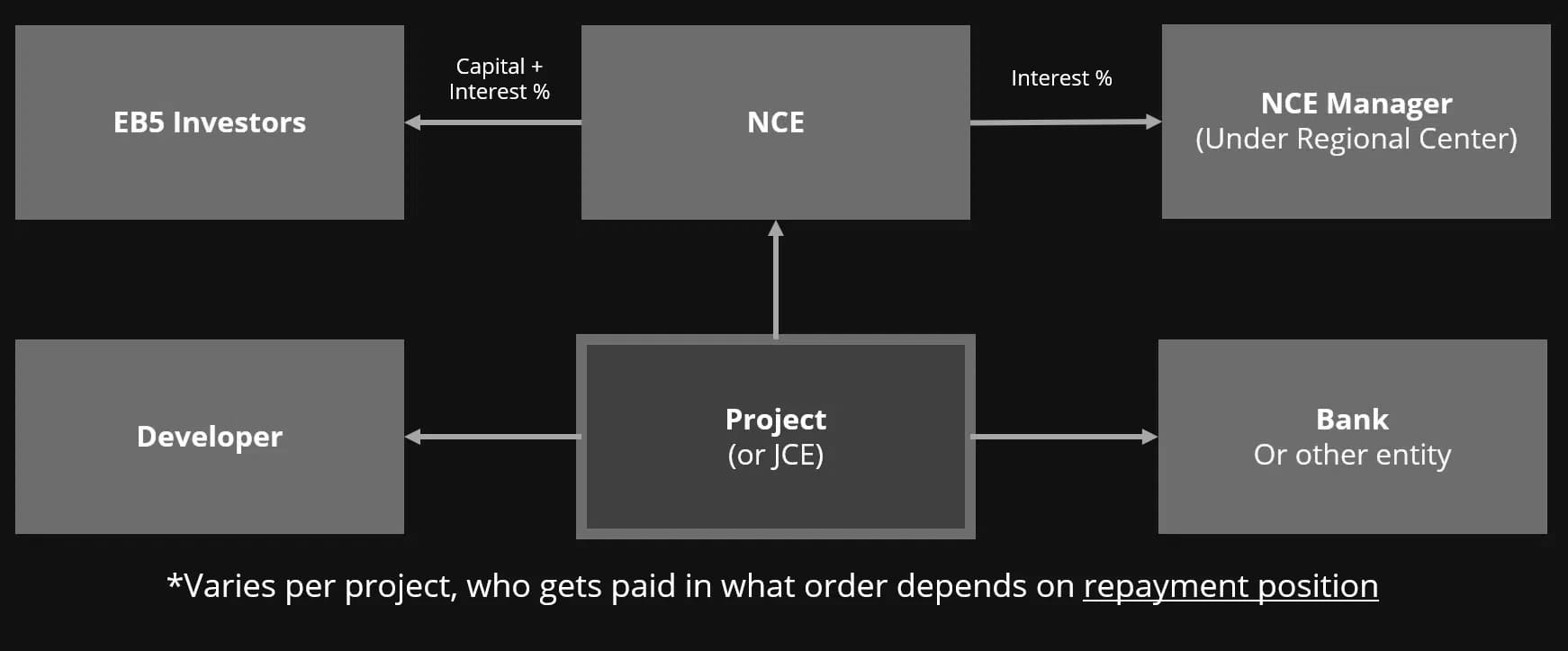
How does the EB-5 Repayment Process work?
How is a typical EB-5 Project Capital Stack structured?
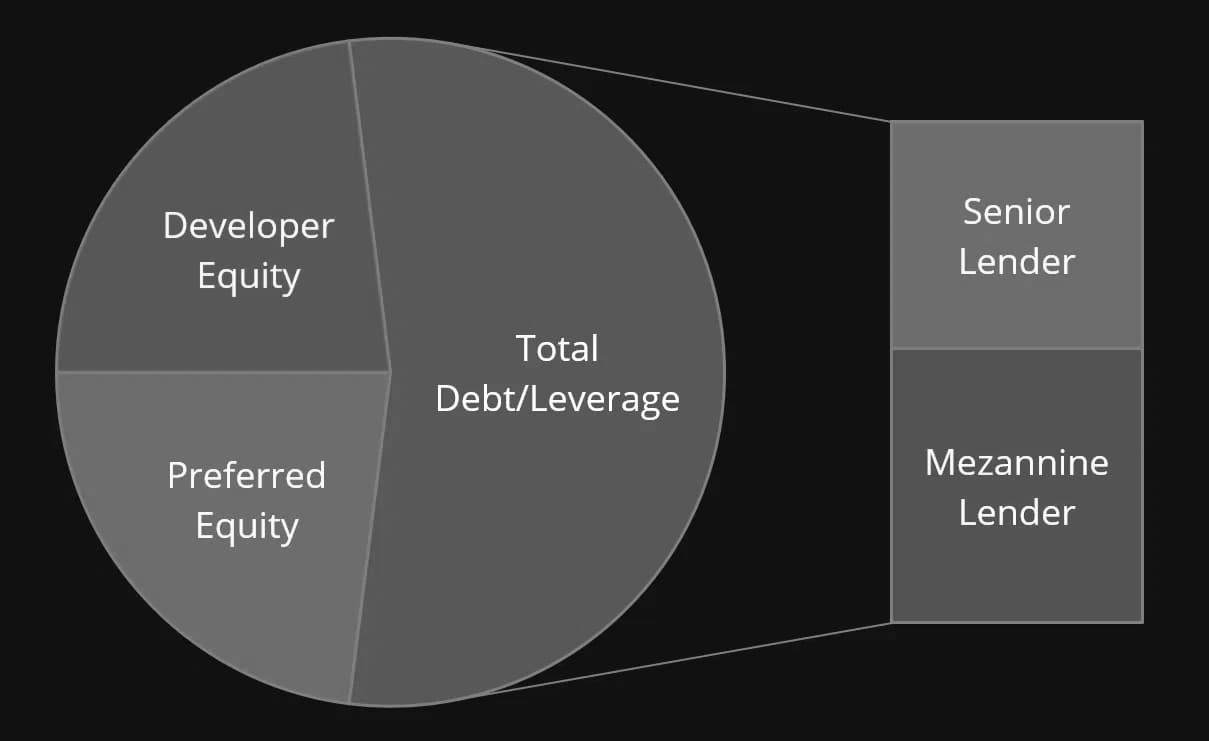
Senior Lender: The Senior Lender holds the first position in the capital stack, meaning they are first in line to be repaid. If there is a default on the loan agreement, the Senior Lender has the right to foreclose on the property and liquidate it to recover their funds. This position is often occupied by a bank but can sometimes be held by the EB-5 fund.
Secondary or Mezzanine Lender: The Secondary or Mezzanine Lender holds the second position in the capital stack, making them second in line for repayment. The Senior Lender must be fully repaid before the Secondary Lender can recover any funds. Most EB-5 project loans are secured in this second position, so it is crucial to understand the size of the senior loan relative to the project.
Preferred Equity Position: Investors in the Preferred Equity position receive profits from the project until their preferred return is paid. Unlike a loan where interest is earned from the moment funds are lent, returns for Preferred Equity investors are dependent on the projects profitability. Recovery of the investment relies on the NCEs ability to liquidate through a sale or refinance, and there may not be a fixed maturity date. The specific structure of Preferred Equity offerings can vary, so it is essential to review the offering documents for each project.
Pari Passu Equity Position: Pari Passu Equity involves a profit-sharing arrangement between the NCE Manager and/or developer and the investor. This is generally the riskiest part of the capital stack, as it relies entirely on the projects profits to pay returns. Investors in this position typically depend on selling their share of the NCE to recover their investment. The risk and return profile of your investment is significantly influenced by your position in the capital stack, the current value of the asset, the progress of construction, and the likelihood of the projects completion.
What is EB-5 Job Creation requirement?
The EB-5 visa program requires investors to invest the necessary amount of capital into a new commercial enterprise that will generate at least 10 full-time positions for qualifying employees. For enterprises within a Regional Center, these full-time positions can be created directly or indirectly by the new commercial enterprise.
- Direct Jobs: These jobs involve a direct employer-employee relationship between the new commercial enterprise and its employees.
- Indirect Jobs: These jobs are created outside the new commercial enterprise but result from its operations and economic impact.
Meeting these job creation requirements is essential for EB-5 investors to secure and maintain their Green Card status.
How are Job Creation methodologies used to show Job Creation in the Regional Center Program?
In the Regional Center Program, job creation is demonstrated through various economic impact models rather than by counting individual employees. The USCIS allows Regional Centers to use these models to connect the amount of money spent on a project with the number of jobs created. This approach means that if the funds are spent on the project as specified, the jobs are considered created and permanent. These methodologies leverage economic multipliers and input-output models to estimate the total employment impact, including both direct and indirect jobs. By using these economic impact formulas, Regional Centers can effectively demonstrate that the investment has met the EB-5 program's job creation requirements, providing a reliable path for investors to fulfill the conditions necessary for obtaining and maintaining their Green Cards.
What is a Targeted Employment Area (TEA)?
A TEA can be, at the time of investment, either:
- A rural area; or
- An area that has high unemployment (defined as at least 150% of the national average unemployment rate).
A rural area is any area other than an area within a metropolitan statistical area (MSA) (as designated by the Office of Management and Budget) or within the outer boundary of any city or town having a population of 20,000 or less??? according to the most recent decennial census of the United States.
A high-unemployment area may be any of the following areas
- An MSA;
- A specific county in an MSA;
- A county in which a city or town with a population of 20,000 or more is located; or
- A city or town with a population of 20,000 or more outside of an MSA.
A high-unemployment area may also consist of the census tract or contiguous census tracts in which the new commercial enterprise is principally doing business. This may include any or all directly adjacent census tracts, if the weighted average unemployment for the specified area based on the labor force employment measure for each tract is 150% of the national unemployment average.
Source: USCIS
What is YDY CAPITAL role in the EB-5 Process?
YDY CAPITAL collaborates with well-capitalized developers to structure high-quality EB-5 investment products tailored for foreign investors. The primary goal of YDY CAPITAL is to ensure that its qualifying EB-5 investment products create more than the requisite number of jobs for all investors, thereby meeting the program's job creation requirements. To provide investors with peace of mind, YDY CAPITAL employs robust investor protections and adheres to industry best practices. The principals of YDY CAPITAL have a proven track record, having assisted over 1,000 investors in obtaining more than 2,000 Green Cards for their family members. Impressively, YDY CAPITAL maintains a 100% approval rate for both I-526 and I-829 petitions, demonstrating their commitment to successful outcomes for their clients.
CLIENT TESTIMONIALS
Trusted By EB-5 Investors Worldwide
We provide transparent reporting, protect investor interests, and act as your fiduciary from diligence to exit.
Disclaimer: The individuals referenced in these testimonials are investors in EB-5 projects and have not received compensation for their feedback. Their statements reflect personal experiences and opinions and do not guarantee future results.
